Sunday, July 01, 2012

It's a truth universally acknowledged...


 It's a truth universally acknowledged... that Jane Austen knew her stuff. No question. If you doubt me, read these extracts from “The Wit and Wisdom of Jane Austen”. In letters to her niece Anna Austen, written in 1814, she offers tips on the novelist’s art.

Listen to this advice about writing what you know:

We think you had better not leave England. Let the Portmans go to Ireland, but as you know nothing of the manners there, you had better not go with them. You will be in danger of giving false representations. Stick to Bath and the Foresters.

On practical plotting:

Your aunt C. does not like desultory novels, and is rather fearful yours will be too much so, that there will be too frequent a change from one set of people to another, and that circumstances will be sometimes introduced of apparent consequence, which will lead to nothing. It will not be so great an objection to me, if it does. I allow much more latitude than she does – and think nature and spirit cover many sins of a wandering story…

On the need for consistency in characterisation:

I like your Susan very much indeed, she is a sweet creature, her playfulness of fancy is very delightful. I like her as she is now exceedingly, but I am not so well satisfied with her behaviour to George R. At first she seemed all over attachment and feeling, and afterwards to have none at all; she is so extremely composed at the Ball, and so well-satisfied apparently with Mr Morgan. She seems to have changed her character.

On finding a situation that works, and the right sort of character-chemistry:

You are now collecting your people delightfully, getting them exactly into such a sport as is the delight of my life; - 3 0r 4 families in a Country Village is the very thing to work on – and I hope you will write a great deal more, and make full use of them whilst they are so very favourably arranged. You are now coming to the heart and beauty of your book…

Not much different to the advice writers get two hundred years on. The more things change, the more they stay the same.

Wendy

Friday, June 22, 2012

The War of 1812: The Battle of Stoney Creek

First off, I want to say hello.  This is my first post here at Romancing the Past and I'm thrilled to be here.

I don't live in England where my historical books are set, so much of my knowledge of the past is second hand but when it comes to one small slice of Regency history, I live smack dab in the middle of it - and that is the War of 1812.  Seriously, I grew up in Niagara, next to Lake Ontario, where most of the fighting took place, and now, I live down the street (literally) from what was then Burlington Heights and is now Dundurn Castle.

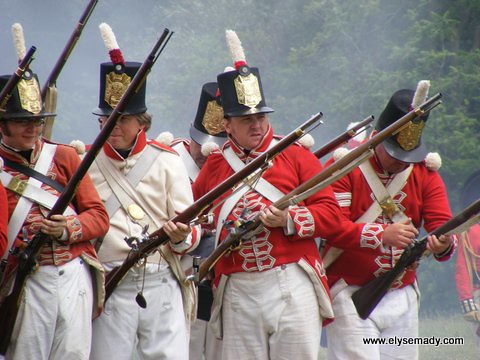
StoneyCreek1813 (58)
British Soldiers reenacting in period uniforms
In the grand scheme of things,the War of 1812 was a pretty minor war, notable mostly for producing Laura Secord's famously delivered message and for the Brits burning down the White House in 1814.

It was also the first war in which the Americans declared war on a foreign power and frankly, they weren't expecting a lot of resistance, assuming that the residents of Upper and Lower Canada would welcome 'annexation' from the dastardly British with open arms.

Not so much.  Hence the whole 'at war thing' that ensued over the next two years.

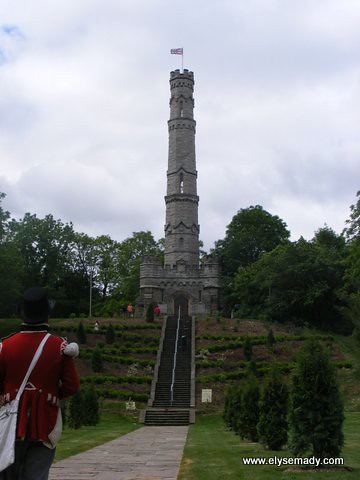
StoneyCreek1813 (7)
The Memorial commemorating the Battle of Stoney Creek
2012 is the start of Bicentenary Celebrations throughout the Great Lakes region and my family and I went to visit a reenactment on the site of one of the key battles of the era recently.  It was a great day.

A copy of the original map of the battlefield

The Battle of Stoney Creek was a critical one for the British in terms of defending Upper Canada.  Vastly outnumbered by the Americans and forced to beat a hasty retreat to Burlington Heights, on the night of June 5, 1813, 700 British soldiers  attacked under cover of darkness and were able to drive the 3500 American troops back to Forty Mile Creek (Grimsby, ON) and later to Fort George (Niagara on the Lake, ON)

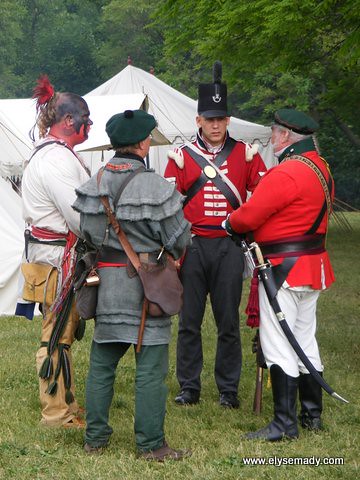
StoneyCreek1813 (20)

The day itself was interesting because not only did they provide an overview of the military strategies that the armies would have employed but also included access to the memorial that was built 1913, and a whole range of activities like baking over an open fire, making traditional recipes like oat cakes, presentations talking about the contributions of Native allies like Tecumseh, what life in British North America was like for settlers and more.  My six year old's favourite part were the explosions during the artillery display.  Typical guy :)

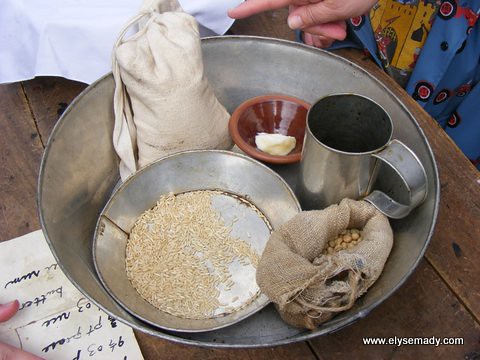
StoneyCreek1813 (12)

The rations a British solider   A wife got 1/2 of that; kidlets 1/3.  

Sometimes it can feel like history is a long way away - geographically and temporally.  It's nice to be reminded that it's often much closer than we think.  I took lots and lots of photos so feel free to check them out on Flickr.  I think they capture the experience really well.  And if you're in the region and get a chance, be sure to visit some of the great events that will be taking place over the next while.  It looks like they've got some fascinating things planned that will really bring history to life.

Tuesday, June 19, 2012

Regency Nicknames

If there’s one thing at which the British excel, it’s inventing nicknames. (My favorite will always be the twentieth-century brain child of author Evelyn Waugh. Waugh called the Earl of Antrim “Lavatory Chain,” for the simple reason that he was always flushing.)

The Carlton House set, the collective name for the Prince Regent’s friends in the early 1800s, raised the practice of nicknaming to an art form. Some of these names are already familiar to regency readers, and more or less self-explanatory. Frederick “Poodle” Byng had light curly hair and kept a poodle, giving rise to the inevitable comparison. Edward Hughes Ball Hughes (he added the second “Hughes” in 1819 after his grandmother’s second husband, Admiral Edward Hughes, left him an enormous fortune of 40,000 pounds a year) was rich and handsome enough to be known as The Golden Ball. And, of course “Beau” Brummel is much better known today by his nickname than by his given name of George.

Others from the same set are a bit more obscure. Thomas Raikes was the son of a merchant banker, a famous dandy and friend to the great. He was said to have “risen in the east [the City, the financial center of London] and set in the west [Mayfair, the fashionable end of Town],” which led in a roundabout way to his being nicknamed after the sun god, Apollo. Lord Yarmouth, later Marquis of Hertford, was known as “Red Herrings,” since he was ginger-haired and Great Yarmouth was a thriving port for the herring industry. Joseph Haynes earned no less than three nicknames: for the color of his coats, he was known as “Pea Green” Haynes; for his rivalry with the wealthier Golden Ball, he was known as “Silver Ball”; and when he proposed to the famous actress-courtesan Maria Foote, he became known as—what else?—“Foote Ball.”

Maria Foote

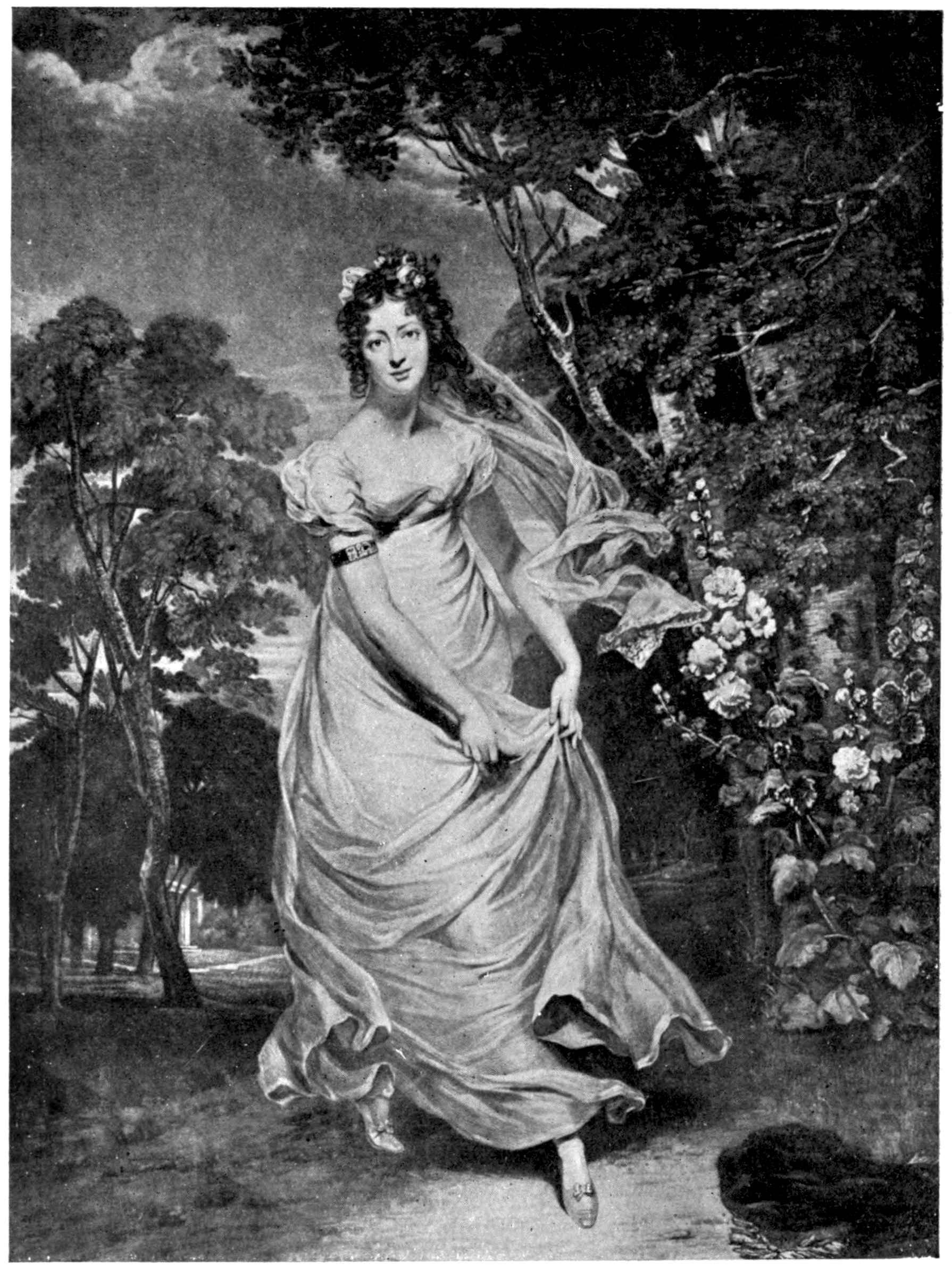
Maria Foote won a breach of promise suit against Pea Green Haynes before marrying the more loyal Beau Petersham.

Having been persuaded by friends that Maria was perhaps a bit too scandalous for matrimony, Haynes twice broke off their engagement; Maria sued him for breach of promise and won 3,000 pounds. She went on to marry a much higher-profile member of Prinny’s set, the older but kindhearted 4th Earl of Harrington, known during the regency by his courtesy title of Lord Petersham. After the court and most of the ton refused to receive the new Lady Harrington, the earl angrily withdrew from public life, even telling Queen Victoria when she visited Derbyshire that he would only receive her at Elvaston Castle if she ordered him to do so. Lord Petersham enjoyed two nicknames; “Snuff” for his habit of taking snuff and collecting snuffboxes (he had a different one for every day of the year); and “Beau” after his reputation, like Brummel’s, for being a dandy and trendsetter.

Lord Foley's disastrous balloon launch.

The 2nd Lord Foley, an early champion of flight, was known as "Lord Balloon" after the abortive September 29, 1784, launch that ended with a hot air balloon ablaze in his Portland Place garden.

Nicknames were often as uncomplimentary as they were descriptive. Lord Petersham’s cousin, Lord Sefton, was known as “Lord Dashalong” for his unrestrained style of driving. Captain Gronow, who went on many years later to write his Reminiscences of regency life, was short enough to be called “NoGrow.” Lord Foley, 3rd Baron Foley, was known as “Number Eleven” for his skinny legs—but at least that was a more clever nickname than that given his father, who was called “Lord Balloon” after a hot air balloon launched from his garden failed to get off the ground, leading disappointed onlookers to form an angry mob and attack the balloonists. It's never a good thing when a nickname immortalizes a dramatic public humiliation.

What about you? Do you have a favorite historical nickname, whether real or fictional?

Alyssa Everett's debut regency romance, Ruined by Rumor, is currently available from Carina Press. She hopes you'll visit her website and follow her on Twitter and Facebook, where she promises not to spam you relentlessly.

Friday, June 15, 2012

The Inspiring Journal of Louisa May Alcott


Recently, I moved a ton of books from my den into my writing. In the process of moving, I came across book I've had for many years. Revisiting it gave me a new appreciation for the author of LITTLE WOMEN, Louisa May Alcott.

The journals consist of her diary entries from the time she was eleven years old until four days before her death. She was what I consider a "true" writer. A person who is born to tell stories. Despite hardships, setbacks, rejection, criticism, they continue to write because this is who they were born to be.

Here are a few excerpts from her journals, which most writers can relate to.

March 1846 (age 13) I have at last got the little room I have wanted so long and am very happy about it. It does me good to be alone and Mother made it very pretty and neat.

1852  My first story was printed and $5 paid for it.

Jan 1855 The principal event of the winter is the appearance of my book, "Flower Fables." I will put in some of the notices as "varieties." Mothers are always foolish over their first-born. Paid $32

May 1862 Mr Fields did say "Stick to your teaching, you can't write." Being willful, I said, "I won't teach and I can write, and I'll prove it."

November 1864  Proof began to come and the chapters seemed small, stupid and no more my own in print. I felt very much afraid that I'd ventured too much and should be sorry for it. But Emerson said, "that what is true for your own private heart is true for others."   (Love that remark)

Feb 1865  Being tired of novels I soon dropped it & fell back on rubbishy tales, for they pay best and I can't afford to starve on praise when sensation stories are written in half the time & keep the family cozy.

Sept 1866 Went to the wedding and had a dull time. Ticknor added to my worries by sending word the manuscript of the fairy tales was lost.

April 1870 A happy month for I felt well for the first time in 2 years. I knew it wouldn't last but enjoyed it while it did. Little Men was out the day I arrived. 50,000 copies sold before it was out.

Oct 1872 Went to a room on Allston Street. I can't work at home, and need to be alone to spin like a spider.

Jan 1874 When I had the youth I had no money, now I have the money, I have no time and when I get time, if I ever do, I shall have no health to enjoy life.

Jan 1875 Fame is an expensive luxury. I can do without it. I asked for bread and got a stone in the shape of a pedestal.

July 1876 Get an idea and start "Rose in Bloom," though I hate sequels.

May 1877 Felt very well and began to hope I had outlived the neuralgic worries and nervous woes born of the hospital fever and hard years following.

Dec 1884 Began again on "Jo's Boys" as Niles wants a new book very much and I am tired of being idle. Wrote 2 hours for 3 days, then had a violent attack of vertigo and was ill for a week. Head won't bear work yet.

Mar 1886 A little better. Dr says I may write next week and get my heard free from stories that haunt me and keep me awake. Wise man.

July 1886 Finish "Jo's Boys" ...much rejoicing over new book.

Jan 1887 Sick day. Lay quietly and lived in my mind where I can generally find amusement for myself...Lay late and forgot my woes in my story. A happy world to go into when the real one is too dull or hard.

Dec 31, 1887 Thank the Lord for all his mercies. A hard year, but over now.

Feb 27, 1888 Wrote on "Sylvester."

March 2, 1888 (Her last entry) Better in mind but food a little uneasy. Write letters. Sew. Write a little. Lulu to come.  (Louisa died the following Tuesday)

Louisa was born in 1832 and died in 1888 at the age of 55, probably of lupus-type disease. She grew up in a cottage in Massachusetts and was the second of four daughters. She had an independent streak and she never married. Louisa worked as a seamstress and a teacher as well as a writer to help out her family financially. Her father, an educator, was never able to support his family. Some of her early education was provided by Henry David Thoreau. She also received instruction from Hawthorne, Emerson and Margaret Fuller, who were family friends.

Her journals give a glimpse into her life, which was not an easy one. I related to her struggle to work at her regular jobs as a teacher and seamstress while writing, too. Plus, as the years passed, her health declined. She contracted typhoid fever while working as a nurse during the Civil War. Later on, it has been determined that she possible had an auto-immune disease that eventually killed her.

Her journals, which she wanted destroyed after her death, were wisely preserved and such an inspiration to read now. I bow to her!

Patricia Preston
www.patricia-preston.com

Thursday, June 14, 2012

Finding Love in Ancient Rome


The modern idea of romantic love, as the most causal of history buffs know, has not been well embraced across the ages.  Over the centuries, the inequalities between men and women made ideal romantic relationships virtually unknown. People didn’t marry for love, but for a host of other, more practical reasons.

Life in ancient Rome was no different. Girls stopped receiving formal education around age eleven, and between the ages of twelve and fourteen, were considered 'ready to marry.' Often, economic conditions and inter-family relationships were deemed more important than love, and these young ladies often found themselves pawns in power games beyond their control.

Typically, women in Rome lived their lives under the auspices of a man: father, brother, uncle, husband, son, depending on the season of her life. He controlled the money (until late in the Roman Empire) and thereby controlled the women in his care. When a woman married, a dowry went from her pater familia to her new husband in a symbolic transfer of power over her. Even when defining relationships, women never won. They were legally forbidden from adultery, though men were not, and while homosexuality among men was tolerated, lesbianism never found any such equal footing. 

All this is not to say women had no power. Power is gained where one can find it. A wife and mother was the power behind the family and home, and could wield considerable strength. She saw to the education and upbringing of any children, and while she didn't earn a salary, she often decided how and where money was spent.  

We can intuit that true love did blossom between men and women, that spouses who were forced together grew to love one another, that pairings to groom political favor or gain economic advantages did not necessarily exclude the woman from a good quality of life or a loving spouse.   

And, as you may know, many of our traditional wedding symbols come from ancient Rome.  The wearing of a ring on the third finger of the left hand symbolized an engagement. The bride wore a white gown and veil and was attended by a ‘bridesmaid.’ And the month of June was favored by the gods for pairing, and so continues to be the highlighted month for modern weddings. 

I’m interested to hear your take on this question: have we romanticized the past to bring it more in line with modern views…or do modern marriages still look to create advantages, whether economic, political, or personal?

________________

Find my social media links and book purchase links at my website.

Saturday, June 09, 2012

How do you do it?


That’s what all my friends ask me. “How do you do it? How do you write so many stories? How do you consistently put out huge numbers of pages?”

My answer -- one word. Discipline. Rigid, unbending discipline.

In the rest of my life, I’m a pretty laid back character. If I don’t have to report somewhere early in the day, I sleep late. I don’t do housework. I don’t weed my garden. I don’t repot my orchids, poor things. But when it comes to my writing, I pound out 5,000 words per week. More if I need to.

I don’t do this because I’m a virtuous writer. I do it because I have so many books I want to write, and the only way I can get to them all is write as quickly as I can. On the other hand, spewing out thousands of words that I’ll have to throw out later won’t get me to the goal. What I need to do is put out small(er) amounts of pages but do it consistently.

About now, you may be expecting the First Commandment of Writing: “Thou shalt write every day.” I don’t know who thought that one up, but I’m pretty sure it’s responsible for a lot of writerly guilt and depression. Forget it. You need to set your own schedule and stick to it.

My trick for doing that is simple math. You can do it easily with a calculator. I found out early on that if I wrote 5,000 words per week, I could move along at a satisfying clip. I currently have three-day weekends. Five thousand divided by three equals 1,667. Every Saturday, Sunday, and Monday, I write 1,667 words. There’s no magic involved, just discipline. And note, I haven’t written every day.

If something comes up and I can’t get my writing done one day, I can make that day’s output up on my lunch hours. Again, get out the calculator. Four into 1,667 equals 417 words per day. I write 417 words on my lunch hours until I’m caught up.

I can apply the same principle to increase my output over 5,000 words per week. To give you the most extreme example, if I want to wrote 10,000 words per week, I can do my regular weekends and add another 5,000 words by doing 417 words early in the morning on weekdays, 417 at lunch hour, and 417 after work. You can move along really fast at that rate, although I only do it for very short stints. After that, I’m exhausted.

When I get to a place where I have to produce that many words, I often resort to Write or Die. Check it out at

I don’t own stock in the company. In fact, it isn’t a company at all. It’s another writer masquerading as evil scientist, Dr. Wicked. Believe me, you will produce words.

You might answer that that’s all fine if you have the words to push out, but what if they won’t come at all? To which I say, write anyway. If you’re at a point where you can’t think up a single situation or a single character or a single story that interests you, you’re beyond any help I can give.

I think, instead, we edit and censor ourselves when we’re feeling down. We want every word to be perfect and are convinced that we’re writing crap. Fine. Give yourself permission to write crap. As the great Nora Roberts once said, “I can fix a bad page. I can’t fix a blank page.” Get it down now and fix it later. I often discover that what I thought stank when I wrote it often turns out to be not so bad on when I read it later. Sometimes, it’s even good.

Life is too short to spend even a moment in misery. For some reason, probably a break in your DNA somewhere, you decided to become a writer, thereby guaranteeing yourself huge, heaping helpings of misery, all dispensed by well-meaning agents and editors everywhere. Don’t pile more onto yourself. You need to be producing stories. Make yourself do it. You’ll be glad you did.
www.writeordie.com. You can use this insane device online for free or download it onto your computer for $10.00. You turn it on, tell it how many words you want to write in what amount of time, and start writing. If you stop writing, there are consequences. The normal punishment for slacking off is a really annoying noise. In the worst case scenario, when your typing stops, Write or Die erases what you’ve already written.

Tuesday, June 05, 2012

Myth-tory

Longer ago than I'd like to admit, when I was a teenager just beginning to read romance, I regularly encountered all the following scenarios and accepted them without question:

1) Lord Ravenwolfscar and Miss Pureheart can inherit a fortune...but only if they marry within six months of the death of Ravenwolfscar's uncle, Lord Manipulative-Moneybags.

2) The year is 1740, and our braw hero Hamish is instantly recognizable as a member of Clan MacSexylegs because he invariably wears his family's own distinctive tartan.


3) Lord Unlucky is dying without a legitimate son, so he weighs the worthiness of assorted nephews, cousins, and his own bastard son to determine where he should leave his titles and lands.

4) Lord Hesitant and Miss Doubtful must marry to protect her from an unwanted suitor, but they promise themselves not to consummate the marriage so they can have it annulled and go their separate ways once the danger is past.

Thing is?  None of these scenarios could've happened, at least not in the Georgian/Regency milieu I currently write in.

1) The law frowned upon coerced marriages, even if the coercing was being done from beyond the grave.  What Lord Manipulative-Moneybags could do was include a clause in his will saying Lord Ravenwolfscar must marry by his 30th birthday to claim the fortune without specifying a bride, which still gives the author plenty of room for plot conflict.

2) While the kilt itself has been around since the 16th century, formalized, clan-specific tartan setts date back no earlier than the Victorian era and were something of a marketing ploy.  There were regional tartan patterns earlier on, so a group of, say, Gordons might all be wearing the same tartan because they all got it from the same weaver, but it wouldn't have broken a rule or been a breach of etiquette for a Fraser or Macdonald to wear the pattern as well.

3) Who inherits a title when a man dies without a legitimate son is a blog post in itself, but suffice it to say it's not the dying lord's choice, and he can't legitimize a bastard child.  (Note that birth is what counts, not conception--if he marries his pregnant mistress as she's going into labor, the baby can inherit.)

4) The law didn't allow annulments for non-consummation.  If the husband were impotent, incapable of consummation, it'd be a different story.  But having spoken the vows, the couple couldn't just get a takesie-backsie by saying, "Oops, we didn't really mean it, and we haven't Done It, we swear!"

I expect to get some reader comments on #4 when my November book, An Infamous Marriage, comes out, because the hero and heroine marry in Chapter Three but don't consummate it till Chapter Twelve--which, incidentally, comes after a five-year time jump.  You see, when they first marry she's still grieving her first husband, and then the hero gets sent away on military service in Canada.  But it never even occurs to them to seek an annulment, because they know darn well the option doesn't exist.

As a reader, sometimes these and similar errors bother me enough to throw me out of a story, but sometimes they don't.  (Of the four, I'm most forgiving of the kilt, because it's not like the plausibility of the whole plot stands and falls on the hero's wardrobe.)  If the writer hooks me hard enough, I can make my inner nitpicker sit down and shut up for the duration.  Well, not if the error is New World foods in Europe before 1492.  The line must be drawn somewhere.


What about you?  How tolerant are you of myth-tory in your history?

Friday, June 01, 2012

Posting Letters Regency Style and other stuff


We’ve been travelling the English West Country this last fortnight and what a feast of historical discovery it’s been. Let’s say straight away that I now understand why so many famous writers and artists were inspired by the area. There’s just something about it that stimulates the creative juices.

One of the writers I most admire is Daphne duMaurier. Frenchman’s Creek happens to be my favourite of her novels so I was determined to see the famous creek where the fictitious French boat came and went, seemingly at will. 

As you will see from this picture of the river, it’s very pretty and even more secluded so I guess the Georgian forces being outwitted by her loveable pirate is fairly believable. I'd often wondered about that.


On to Dartmouth and the almost four hundred year old buildings that are now the Royal Castle Hotel.  In the early 1800’s, with the coming of the turnpike and an easier gradient into the town, The Castle Inn became a proper coaching house.  Agatha Christie’s home is nearby and she once resided at the hotel, using its wonderful library to write one of her books. The shelves are still lined with ancient leather bound tomes - Justice of the Peace Volume XOV 1931 and Public General Statutes 1883 to name but two. 


This is me posing at the typewriter Agatha herself might well have used.


In Lyme Regis we were fortunate enough to stay at the original post office, now a guest house.  It first became a post office in 1799 with John Norman as its postmaster. Jane Austen famously spent two seasons in Lyme and almost certainly posted a letter to her sister Cassandra in the original box, photographed here, on 14th September 1804. 

It’s called an ostler box. The lower slit is for pedestrians, the upper one being more convenient for men on horseback to use. There was no such thing as envelopes or stamps in those days so the postmaster would have used a wooden stamp to frank Jane’s letter.


Corfe Castle, dating back to the 11th century, was another delight. Mary Banks led the defence of the castle against Parliamentary forces, holding out for six weeks until betrayed from within her own ranks.


All in all, it’s been an exhausting but hugely enjoyable trip back in time.

Wendy

Friday, May 25, 2012

The Importance of Scenery

Scenery is not only important in a story for your reader to "see" the setting of the book, but its also important for writers to be able to see that scene vividly in their minds. Obviously as writers we might have a grand imagination and most of the time can picture our settings in our minds. But I really love to get visuals on settings. It helps me to not only put myself in that scene, but to get a sense for everything that might be happening--the temperature, the weather, the scents, the surroundings, and also a real live picture can really get the mind working creatively.

Recently, we took a trip to the Smoky Mountains and went hiking at a botanical gardens. It was different than any other garden I'd been too--it was just all natural greenery. I took tons of pics because even though I write in historical European settings a lot of the places I saw were bringing my own story ideas to life.

My advice--if you pass something in your daily travels that you think would be a great setting for your book, take a picture.

This reminded me of  a road that my characters might ride on in a carriage or by horseback.


Perhaps a cave where characters might seek shelter from the rain.


Took this in the car, I just couldn't resist the rolling hills and water.


Doesn't this bridge bring all sorts of scenes to mind?


A babbling brook my character might stop to drink at.


Saturday, May 19, 2012

Hanging offenses

My debut romance, Ruined by Rumor, comes out this Monday, May 21. It’s the story of a shy, dutiful politician in love with the acknowledged beauty of his neighborhood, though she’s engaged to a dashing soldier. I wanted to give my hero a political cause he could feel passionate about. Then I read this description of public executions, from Hanging in the Balance: A History of the Abolition of Capital Punishment in Britain by Brian P. Block and John Hostetter:
According to The Times the crowds at the hangings made the atmosphere like that of a fairground and included ‘the dregs and offcoursings of the population of London...Irish labourers smoking clay pipes and muzzy with beer, pickpockets plying their light-fingered art, little ragged boys climbing up posts...’ As to the hangings, the newspaper continued; ‘In an instant [the executioner] withdrew the bolt, the drop fell...They died almost without a struggle...The mob during the terrible scene exhibited no feeling except one of heartless indifference and levity.’
I figured that was something my hero would feel strongly about.

Before Britain established its first modern police force in 1829, the nation’s chief weapon in the fight against crime was the threat of execution. Property crimes--robbery, burglary, even vandalism--were punished as severely as murder. Children as young as seven could be held criminally liable. And because forgery, coining, and “uttering” (passing forged or counterfeit currency) constituted high treason, those crimes were likewise punishable by death—in fact, until 1790 women convicted of such crimes were burned at the stake. A woman could also be burned to death for murdering her husband, since he was considered her lord and master and the crime therefore constituted petty treason.

Burned at the stake
Ann Beddingfield was burned at the stake in 1763 for killing her husband.
(The reason women were burned at the stake for treason but men were hanged had to do with the original punishment for the crime, drawing and quartering. Since carrying out such a sentence required the condemned to be stripped naked and even emasculated, women were instead accorded the modesty-sparing courtesy of being burned at the stake. The sentence remained in force even after the penalty for men was changed to hanging. In later years, the executioner began by strangling the condemned woman to spare her the worst agonies of the fire. The last such burning in England so horrified the Sheriff of London that he pushed for the abolishment of the penalty in the House of Commons the following year.)

The Black Act of 1723 alone made more than fifty property crimes relating to theft and poaching capital offenses. By the regency, more than 200 different offenses carried the death penalty. They included sending an anonymous extortion letter, “wandering as or in the manner of gypsies for one month and more,” and impersonating a Chelsea pensioner (a retired army veteran). In 1801, the peak year for capital punishment, 219 felons were executed in England and Wales for crimes ranging from scuttling a ship to sheep theft.

A number of politicians attempted to address the penal code, most of them Whigs. William Wilberforce, best known today as the leader of the British abolitionist movement, introduced a bill in 1786 titled “For Regulating the Disposal after Execution of the Bodies of Criminals Executed for Certain Offences, and for Changing the Sentence pronounced upon Female Convicts in certain cases of High and Petty Treason.” The bill failed, mostly because its twin objectives--making more bodies available for medical dissection and changing the method of execution for female traitors from burning to hanging--lacked a unified message.

Sir Samuel Romilly met with more success in 1808, when he managed to have the sentence for “privately stealing from the person” (picking pockets) reduced from hanging to transportation.
Sir Samuel Romilly
Sir Samuel Romilly, a barrister by training, sought to reform the penal code.
Romilly hoped to work his way systematically through the long list of capital crimes, but his first success provoked a backlash, most notably from the harshly law-and-order Chief Justice, Lord Ellenborough, and the equally severe Lord Chancellor, Lord Eldon. (Lord Ellenborough, who also favored the use of the pillory and the jailing of debtors, had in 1803 added ten new capital crimes to the penal code by sponsoring the Ellenborough Act, which, among other provisions, included the first statutory prohibition of abortion, making it a hanging offense to procure a miscarriage or abortion for a woman “quick with child.”) Romilly’s next three bills, designed to eliminate the death penalty for shoplifting, met with failure in the House of Lords. Romilly did manage in 1812 to repeal the Elizabethan statute that made it a capital crime
Lord Ellenborough
Unlike Romilly, Lord Ellenborough believed whole-heartedly in capital punishment.
for soldiers and sailors to beg or wander the streets without a pass, but when Luddite riots broke out, the resulting government crackdown led to the creation of yet another capital crime, frame-breaking. Though Romilly re-introduced his shoplifting bill in 1812, it was quickly shot down, and Ellenborough and Eldon saw that it was likewise defeated in 1816 and 1818.

Sadly, it wasn’t until after Romilly’s 1818 suicide (he slit his throat in a fit of despair following the death of his wife) that reform met with real success. The 1823 Judgement of Death Act gave judges the ability to commute the death penalty for any offense except murder or treason, and the Punishment of Death Act of 1832 swept aside a third of the old capital penalties. In 1861, a series of Parliamentary acts reduced the list of civilian capital crimes to five: treason, espionage, murder, arson in royal dockyards, and piracy with violence. (Certain military offenses, for example mutiny, continued to carry the death penalty.) Public executions were outlawed in 1868, and beginning in 1908 those under 16 years of age could no longer be sentenced to death. It wasn’t until 1965, however, that the death penalty for murder was eliminated in Great Britain, and not until 1998 that the death penalty was eliminated for treason, piracy, and the remaining military offenses, altogether abolishing capital punishment in the UK.

The account that the hero of Ruined by Rumor, Alex, gives of a hanging he witnessed in London is not based on a specific execution but is a composite of actual cases.

Enjoy friends-into-lovers romance? Ruined by Rumor, Alyssa Everett's marriage-of-convenience regency, debuts Monday, May 21. Alyssa hopes you'll visit her website and follow her on Twitter and Facebook, where she promises not to spam you relentlessly.

Wednesday, May 16, 2012

Dream A Little Dream

The new season of America's Got Talent started this week. I don't watch that much TV but this has always been one of my favorite summer series. I like the variety of acts. Some, of course, are really bad. Then, there are the brilliant ones like this season's Earth Harp. My favorite so far. But, what I really love about this show is the contestants and their dreams.

I think dreams, hope, and happiness are entwined. I just finished writing a story and the core theme is about having a dream and believing in yourself. From experience, I can tell you that nothing is more exciting that pursuing your dreams and having them come true. This year has been a great year for me as a writer but I had to summon up the courage and belief in myself to make it happen. Dreams don't come true unless you act. Wishing is fruitless.

So, if you are reading this and you have a dream, something you would love to accomplish in this lifetime, what are you doing to make it come true? What action are you taking? Are you taking action each day? Doing something to bring you closer to your dream? Are you nurturing hope? If not, you need to start now. Summon up the courage.  Joy will be the end result. 

Patricia Preston
Check out my new website:

Monday, May 14, 2012

Living History Museum


Today we're fortunate to have fellow Carina author Juliana Ross on the blog, telling us about her work as a guide in a living history museum. Over to you, Juliana.

For nearly four years of my life, from age 15 to 19, I spent most weekends between May and October dressed in petticoats, a homespun gown and a bonnet. No, my parents weren’t dedicated historical re-enactors. And, no, I hadn’t developed an obsession with Laura Ingalls Wilder.

I just happened to have one of the best part-time jobs ever. I was a guide at the living history museum in my small town.

Before you get carried away, I urge you to banish all thoughts of Colonial Williamsburg. The museum where I worked was constructed on a far more modest scale. It was a village, pure and simple, made up of a score of buildings that had been painstakingly relocated in the 1960s and 1970s when they’d been threatened with demolition by widening roads or changing tastes in architecture.

The buildings themselves spanned nearly the whole of the 19th century, from a simple one-room log cabin built by some of the first Europeans to settle in central Ontario, where the museum was located, to a spacious late Victorian farmhouse with all the mod cons of the era. There was also a smithy, a print shop, a general store and a tiny church.

I loved that job, although I can still remember how cold it got in the early spring and late fall, when the heat from the fire or woodstove never managed to chase the chill from my bones. And I will never forget how difficult it was to work in the gowns we had to wear, which for the sake of simplicity were cut in a plain, mid-century style, with tight-fitting bodices, close-fitting sleeves and skirts that were full (but not comically so).

Those skirts were forever getting in my way, or catching a spark from the fire, and the sleeves were so tight that I couldn’t raise my arm any higher than my shoulder. No Anne Shirley puffed sleeves for me!

At the end of the day, I’d change out of my 19th-century garb into my shorts and tee-shirt, drive home in my little Toyota, and happily return to my late-20th-century life. So I can’t honestly say I truly know what life as a 19th-century woman would have been like.

But I did learn a few things along the way. I know how to bake bread in a wood-fired oven. I know how to darn socks. I’ve made beeswax candles over an open fire (with a bucket of water nearby in case my clothes caught on fire). And I spent countless hours smoothing the wrinkles from linens with flatirons that cooled before I could count to ten.

None of this, of course, is of much use today, unless my husband and I decide to turn our backs on city life and go back to the land, or take part in one of those reality series where modern families are expected to fend for themselves as pioneers.

But those years at the museum gave me a taste—just a taste—of what life as a 19th-century pioneer might have been like. The feel of heavy skirts as they swirled around my ankles. The perpetual scent of wood smoke in my hair. The sting of chapped, cracking fingers that had been washed too many times in caustic homemade soap. The ache of my shoulders after chopping a mountain of logs for the fire.

I like to think my work in the village has made me a better historian, one who is perhaps more sensitive to the difficulties of life in an age with none of the modern conveniences for which we barely spare a thought. And I really hope that it might, some day, help me become a better writer.

In the meantime, you can count on me the next time you need the creases ironed out of your chemise, a bonnet frill mended or a sock darned. Just don’t ask me to make any more hand-dipped beeswax candles. That hot wax really stings!

Juliana

Saturday, May 12, 2012

We were real once...


When I visited the British National Gallery a few years ago, one portrait really caught my attention. It was Don Justino de Neve by Bartolome Esteban Murillo. What made the portrait stand out was the fat little dog with the red bow painted in the corner. In a room full of formality, the trappings of wealth and power, this little dog staring adoringly at his master added a level of humanity to the sitter.
 

The dog also provided me with a connection to the gentleman, and to all the other people hanging around him who’d been painted with their pets. I know there are artistic symbols attached to dogs, but there is also love and affection that even the passing of a few centuries cannot obscure. It is a powerful reminder that those people in the portraits were real once and, despite the many years between their time and ours, they were not so different from us.   

Wednesday, May 09, 2012

A Brief History of Tequila


In honor of Cinco de Mayo, it might be fun to take a look at the history of tequila. First, let’s dispense with the myth of the worm in tequila, a myth I subscribed to until I started research for this blog. Tequila doesn’t come with a worm (actually a moth larva) in the bottle. Mexcal, another Mexican liquor, may contain the worm. Tequila, however, is only made of the blue agave (Agave tequilana Weber var. ‘azul’), whereas mexcal can be made of any agave. Although the agave is a succulent, it isn’t a cactus but a member of the lily family.

By the time the Spaniards landed in the area we now call Mexico in 1521, the Aztecs had been drinking the fermented juice of the agave for centuries. A beer-like drink octli poliqhui was used in rituals and ceremonies. The Spanish bastardized the name of the drink into pulque. Still, the aguamiel (nectar) of the agave had never been distilled until the Spanish ran out of their own brandy and turned to the local flora to make hard liquor.

The blue agave grows best in state of Jalisco, and it was there that the Spanish first produced tequila in 16th Century, thereby creating the first indigenous distilled spirit. Around 1600, Don Pedro Sánchez de Tagle mass produced tequila near what is now Jalisco. Later, King Carlos IV granted the Cuervo family the first license to make tequila commercially. In 1656, the city of Tequila was founded. Don Cenobio Sauza first exported tequila to the United States in 1873. One hundred years later, the US was importing over a million cases a year.

There are two basic types of tequila -- 100% pure blue agave and mixto, which may contain as much as 40% of other sugars. Tequila can be either blanco (white) or can be reposado or anejo, both of which are stored in oak and take on a golden color. I can personally attest that both white and golden taste really good, especially with the traditional wedge of lime and salt or with a chile pepper mixture appropriately called fuego as a chaser.

Sunday, May 06, 2012

Dead Blonds

Now that I've got a total of four completed manuscripts under my belt (three published or contracted, one under the bed), not to mention a fair number of false starts and abandoned ideas, I'm starting to notice certain subconscious habits and pet words. Personal cliches, if you will.

One of my most consistent cliches--and I swear it was entirely unconsciously done--is the Dead Tall Blond First Husband. In The Sergeant's Lady, Anna's abusive first husband, Sebastian, is blond, blue-eyed, handsome, and over six feet tall.  After his death, she finds happiness with Will, who's brown-haired and a few inches shorter.

The heroine of my upcoming An Infamous Marriage is also a widow. Her first husband, Giles, is entirely the opposite of Sebastian in character. He's kind, gentle, smart, sensitive--he really would've made a lovely beta hero had I been inclined to make him the star of a book.  But he looks  almost exactly like Sebastian, being a tall, blond, golden god type. Again the hero, Jack, is dark and just a smidge shorter.

And that book under the bed? Well, it doesn't actually have a Dead Tall Blond First Husband, but only because it was Book One of a projected fantasy series rather than romance, and my hero hadn't yet met his one true love. The hero in question? Think James from my A Marriage of Inconvenience, albeit 3-4 inches taller. Dark curly hair, bright blue eyes, athletic in a slim, lithe way rather than burly and muscular. In Book Two he was going to meet and fall in love with his eventual wife, with the <i>slight</i> initial objection that she's happily married to someone else. The hero, being heroic, keeps his feelings bottled up until Husband #1 dies--in the hero's arms in the aftermath of a battle, no less--but after that I'd planned to have things get messy, angsty, and passionate in a hurry.  Naturally Husband #1 needed to present some kind of physical contrast with Our Hero, so I immediately pictured him as...you guessed it, tall and blond.

I swear I don't have a death wish for blond men. I can even name several I think are very hot.  I mean, Sean Bean, ammirite?


And Matthew on Downton Abbey (Dan Stevens) is really quite pretty:


But in real life, my husband has black hair, and my ex-boyfriends and serious crushes from middle school on up? Brown or black hair. The last time I wanted to go out with a blond was, oh, fourth grade. So my default hero coloring is dark, and when I want to give the heroine a past with someone handsome, but not really my type, I go blond. And I like writing widows, since it allows me to write heroines slightly older and sexually experienced without needing any complex or historically unrealistic backstory. Therefore, by definition, the men in my heroines' pasts tend to be dead.

Still, I'm due for a blond hero soon.  At the very least, I promise to find a way other than hair color to draw a contrast between my heroes and their heroines' first husbands.

What about you? Writers, do you have Personal Cliches? Readers, have you noticed such patterns in authors you follow?

Friday, May 04, 2012

Pass the Plumber's Rods

Writer's Block.


I am blocked. I think I can stop using other excuses after a year and five months and admit to myself that I am good and blocked and I need to do something drastic about it. You can see I'm blocked by the fact this post is a few days late... Trouble is, when I feel like this, I don't want to do anything writerly. I avoid my online friends, (because they are all writing and there's only a certain number of time before they get fed up with asking about the WIP), I don't want to promote, because I have nothing coming up--it's a bit of a dark spiral into depression, to be honest.


I've been stuck on a Work in Progress, set in 1922 England for well over a year now. I should have finished it (to my own deadline) in December 2010, but I didn't quite do it--being about five chapters short of ending it--and here we are 17 months later and I'm hardly more than two chapters further along.

Oh, granted in that time I have done other stuff, but it's nothing to be proud of. One published short story (let's be honest, I could have written one short story a month, at least, just to keep busy) and a few started new WIPs.


The reason I haven't continued with the new WIPs, even though I've found them interesting and compelling is that I don't want to end up with several unfinished manuscripts. I'm notorious (in my home life) for starting things with great enthusiasm but petering out and losing interest and the thought of that happening to my writing frightens me to death. I don't want this to be a nine day (or even, as it really has been, a nine year) wonder.

So what can I do to push on, get this albatross off from around my neck and get on with something else?

1. Stop playing online games obsessively, for a start.
2. Turn off the internet for two hours a day?
3. Give myself smaller targets. Better, surely to write 300 words a day until I'm back in a groove than to write nothing for 17 months.
4. Use Write or Die, this seems to motivate me (if I can motivate myself hard enough to open Word in the first place, that is!)

As to what causes it with me, I don't really know. I had the same problem when I was writing Transgressions. I just stopped for two years, but at least I was then writing fanfic, so keeping my juices flowing as it were. I wonder if it's a fear that my next book won't be anywhere as well-liked as my last book (Junction X) and then I think that that's stupid, because of course it won't be, but you still have to try and do better and better each time. I know it's not a problem with plots and such drying up as I have more projects in my head and in my WIP folder than I'll ever be able to write, and I am inspired anew every day, so it's not that.

All I know is that I'm sick of it.


Does anyone else have problems like this? I dread to ask, because I know the answer will be no - you lot are all writing!

Wish me luck! I'm going to get the lunch started and then write.

I hope...
~~~~~~
Erastes is the penname of a female author living in Norfolk, England with 3 cats and a mad dog. She writes gay historical novels and short stories with gay themes from many genres. Her two books for Carina are: Muffled Drum (Austro-Prussian War) and A Brush with Darkness (19th Cent. Florence) Her website is www.erastes.com and she can be found easily on Twitter and just about everywhere else.

Tuesday, May 01, 2012

The Old Bailey


I’m having fun writing the second in my series, The Forster Dynasty. The hero is a barrister struggling to make a living by defending common people, who often couldn’t pay him, against the draconian laws of the day. I’m learning quite a lot about the British legal system during the Regency period and about that grand old institution, The Old Bailey, in particular.


The Old Bailey, also known as Justice Hall, the sessions House and the Central Criminal Court is located just off Newgate Street and next to Newgate Prison in the City of London. The Bailey was rebuilt several times from 1674 onwards but the basic design of the courtrooms remained the same. They were arranged so as to emphasise the contest between the accused and the rest of the court. The accused stood at the bar, or in the dock, directly facing the witness box, with the judges seated on the other side of the room. Before the introduction of gas lighting a mirrored reflector was placed above the bar, reflecting light from the windows onto the faces of the accused. This allowed the court to examine their facial expressions and assess the validity of their testimony. A sounding board was also placed over their heads to amplify their voices.

The jurors sat on the sides of the courtroom to both left and right of the accused but from 1737 were brought together in stalls on the defendant’s right, close enough to be able to consult each other and arrive at verdicts without leaving the room. Seated at a table below where the judges sat were clerks, lawyers and the writers who took the shorthand notes which formed the basis of the proceedings.

When the courtroom was remodelled and enclosed in 1737, the danger of infection increased and at one session an outbreak of gaol fever (typhus) led to the deaths of sixty people, including the Lord Mayor and two judges. Subsequently the judges spread nosegays and aromatic herbs to keep down the stench and prevent infection.

A further reconstruction of the Bailey in 1774 saw the area surrounded by a semi-circular wall to provide better security for prisoners and prevent communication between them and the public. The passage between Newgate Prison and the Bailey was also enclosed with brick walls.

The new building provided a separate room for witnesses so that they were no longer obliged to wait their turn in a nearby pub. I bet they still did, though!

Wendy