Showing posts with label erastes. Show all posts

Monday, September 03, 2012

Strawberry and Coffee Creams


You know when you have one of those massive barrels of sweets – usually at Christmas over here in the UK. Quality Street’s the nation’s favourite and they have a great selection of sweets in them. Nut clusters, caramel cups, toffees, fudge etc etc.
And then Christmas is over, and you are left with a handful of sweets that no-one wants.  Orange, Strawberry and COFFEE creams. BLEURGHK.
Now this is obviously only indicative of what my family like – I’m sure there are lots of people who love these flavours, but it does seem to be coffee that is the least favourite, if the brilliant Revels Roulette adverts are anything to go on.
Revels Russian Roulette (Longer Version)


And where am I going with this??? Well, I don't know if you know but I run "Speak Its Name" which is the only review site that concentrates on gay historical fiction and although I have choice as to what books I read for pleasure, when it comes to Speak its Name I have to read a lot of eras that really make me go meh, even before I've opened the book and it's not really fair on the book. I’ve noticed a worrying trend recently, that I tend to leave the westerns till last and right now, out of 40 or so books to be reviewed, more than half of them are westerns.  I hate to say it, but I’ve found that westerns are my coffee creams.
And I’m sorry about this.  I don’t think there are more westerns written than any other gay historical — although, this might be the case, I’ve not done a fact-finding mission to find out — it’s just that, because I’m not mad on the genre, I tend to put them to one side and then I end up with a ton of them to do at once–which doesn’t do anything for my temper or the balance of the site.
I don’t know when I stopped being a fan of the western, either. I used to love them as a child and even went to the cinema to catch classics such as True Grit, and I was such a huge fan of Rawhide (Gil Favour for the win) but now I tend to avoid most of them, except for Slashy goodness such as The Searchers.  (Yes, really.  If you don’t believe me, go and watch it again, John Wayne’s character is most certainly bisexual at the very least.) The very worst western and one that will make me run screaming from the sofa is anything Mexican. Don’t ask me why. I like coffee to drink, and I LOVE strawberries and oranges so nothing really makes sense.
And my aversion to western gay fiction  makes no sense either because there’s been a good few that I’ve really enjoyed.  Mark Probst’s “The Filly” is a beautifully written restrained piece of fiction, Jamie Craig’s “Those Who Cherish” was highly enjoyable, and Kiernan Kelly’s “In Bear Country” duet of books have everything necessary for a reader, adventure, romance and a good historical feel. I don't think that at the moment, Carina Press has any gay historical westerns - that's odd.
So I don’t know why I’ve got this westernphobia. Perhaps it’s because for every good book, there’s three not so stellar with more cliches than tumbleweeds, but then that’s true of every kind of fiction really isn’t it?
Perhaps in future for reviews I’ll take a tip from the Russian Roulette advert and just pick a book blindfold and not allow myself to push the least favourites to the back of the drawer.
Is there any genre you find yourself avoiding?  Is there any logical reason for it (unlike me!)

Saturday, August 04, 2012

Scandal in Cleveland Street


By Erastes

This scandal has lost a lot of its fame due to another homosexual scandal that emerged a year or so later, about a certain Irish poet and a peer of the realm...

But in 1889, there existed a male brothel in Cleveland Street, London. It was a higher class of brothel, set in Fitzrovia, Central London, and attracted a higher range of clients. It was likely that the brothel would have continued unimpeded, for it's very probable that the constabulary were well aware of its existence had it not been for a spate of thefts at the Central Telegraph Office.

Whilst investigating these thefts, Police Constable Luke Hanks was interviewing and searching the staff. Telegraph boys were forbidden to carry personal money on them, as they had to handle money in the course of their business, and Hanks found one young man having the sum of fourteen shillings on him. A sum that was, in that time, the equivalent of many weeks work at the Telegraph Office and one that is worth around £400 in today's money.

When pressed, the telegraph boy, one Charles Thomas Swinscow, admitted that he hadn't stolen it, but had earned it as a prostitute at 19 Cleveland Street, employed by a man called Charles Hammond. He said he'd been introduced to Hammond by others in the Telegraph Office. It transpired that several young men worked for Hammond and statements were taken from them all.

Hanks realised that this matter needed to go further up the chain of command and the case was delegated to Detective Inspector Frederick Abberline. Abberline went to arrest Hammond but he'd fled--one of the young men, Henry Newlove, had tipped him off, but Newlove himself hadn't been able to get away and was taken to the police station. Once in custody, he named names--notable names--and the scandal began to leak out.

He named Henry FitzRoy, Earl of Euston, (who later successfully sued the newspapers for naming him as a client of Cleveland Street), Colonel Henry Jervois, and worst of all Lord Arthur Somerset, Equerry to the Prince of Wales. The police and government were reluctant to act due to the sensitive nature of the business and the high profile accused clients. They continued to search for other clients of the brothel, which of course had been closed down.

Then in August they went to arrest George Veck--a man who posed as a clergyman (an offence in itself) and a close friend of Hammond. A rentboy found in Veck's rooms told the police where to find him, and upon his arrest he was found to be holding incriminating letters from one Algernon Allies. When questioned, Allies said that he'd been working at Cleveland Street--and he confirmed that he'd been in a relationship with Somerset, and had been receiving money for sexual favours. After the police interviewed him, Somerset left the country for Germany.

Shortly afterward, Veck and Henry Newlove went to trial. But guess who their lawyer was? None other than Lord Somerset's own solicitor, Arthur Newton! And guess who paid the legal fees? Yep. Lord Somerset. As you can imagine, the press was having a field day by this point. NOBS NOB RENT BOYS!!! would be the headlines in the press today. The press were vitriolic about the aristocracy indulging in vice.

Due to the fact that Newlove and Veck both pled guilty to indecency, their sentences were "lenient." They were sentenced to four and nine months' hard labour. Other telegraph boys also caught up in the trial were dealt with leniently. Hammond was never extradited and the charges were eventually dropped.

As for Somerset himself--his life was never the same. He attempted several times to return to England, but risk of arrest kept him having to leave again. He eventually spent his life in France.

The trial, with its intermittent flare ups thereafter in the press, which reinforced negative attitudes about homosexuality as an aristocratic vice, kept homosexuality high in the public eye. Details had been available to the public in a way it never had been before. This didn't help Oscar Wilde when, a few years later, he was tried for gross indecency.

Despite the fact that Prince Albert Victor (pictured) had never been mentioned in the press (this was not allowed as he had not been brought into the trial--oh, HOW things have changed, eh?), speculation rumbles on from that day to this as to whether the second-in-line to the throne had ever been a customer of the notorious 19 Cleveland Street. The American press certainly seemed to have no such scruples on the matter:


Erastes lives in Norfolk UK and writes primarily gay historical fiction. She has two novellas out with Carina: Muffled Drum and A Brush with Darkness and is working on another Regency. You can find out about her many books on www.erastes.com 


Tuesday, July 03, 2012

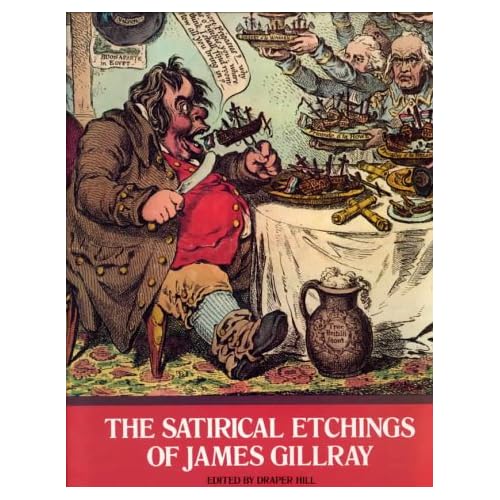
The Satirical Work of James Gillray


By Erastes
He was a withdrawn, silent and lonely man, greatly slandered in his lifetime, probably by his victims and their friends. He worked in such a fury of creative energy that even his acquaintances years before his breakdown, wondered if he might be part-demented. He was so popular that there were often queues at the print shop, above which he worked, waiting for his latest cartoons and caricatures. At once the most ferocious and most brilliant caricaturist of his time, Gillray had a genius for turning public figures into monsters that were yet recognizable, his wild exaggeration being itself a criticism of their personalities.*
Born in 1757, James Gillray was educated at the cheerless and funless Moravian Academy in Bedford and later apprenticed to Harry Ashby, an engraver in the printer's district in London.

When qualified, he broke away from the engraving business and studied at the Royal Academy. He set up his own studio and intended to paint portraits but he was not patronised and eventually he had to return to the money-spinning business of engraving.


A Little Music or the Delights of Harmony

After experimenting with social subjects, such as the etching above, he started to do political satire and his popularity flourished. No-one was safe from his earlier work, neither politician nor royal prince.

The Prince of Wales

He worked exclusively for Hannah Humphreys in Bond Street, and moved into the premises.

Towards the end of his career Gillray's primary target was Napoleon Bonaparte and as "Little Boney"s power and ambition increased so did Gillray's caricatures of him become ever more extreme.

He was eventually given a "pension" by the Tory government, after which his attacks concentrated less on the Tories, and more on the Whigs... Perhaps the Whigs should have given him a pension too...

When his eyesight began to fail, and he was no longer able to create the quality of work he had been used to do, he began to drink and sink into depression.

Sadly, in 1811, Gillray attempted suicide by throwing himself from the attic of Humphrey's shop, after which he was deemed insane. Hannah Humphreys tended to him until the day he died in June 1815.

* The Prince of Pleasure, J.B. Priestley.
James Gillray Online

Erastes is the penname of a female writer who lives in Norfolk, UK with 3 cats and a daft dog. She cares for her dad full time and tries to write in the spaces between the lost keys, spectacles, keys, slippsers and keys. She is dedicated to gay historical fiction and her mission in life is to raise the profile of it so no one thinks it's an odd subject! You can find out more about her many books on www.erastes.com

Friday, May 04, 2012

Pass the Plumber's Rods

Writer's Block.


I am blocked. I think I can stop using other excuses after a year and five months and admit to myself that I am good and blocked and I need to do something drastic about it. You can see I'm blocked by the fact this post is a few days late... Trouble is, when I feel like this, I don't want to do anything writerly. I avoid my online friends, (because they are all writing and there's only a certain number of time before they get fed up with asking about the WIP), I don't want to promote, because I have nothing coming up--it's a bit of a dark spiral into depression, to be honest.


I've been stuck on a Work in Progress, set in 1922 England for well over a year now. I should have finished it (to my own deadline) in December 2010, but I didn't quite do it--being about five chapters short of ending it--and here we are 17 months later and I'm hardly more than two chapters further along.

Oh, granted in that time I have done other stuff, but it's nothing to be proud of. One published short story (let's be honest, I could have written one short story a month, at least, just to keep busy) and a few started new WIPs.


The reason I haven't continued with the new WIPs, even though I've found them interesting and compelling is that I don't want to end up with several unfinished manuscripts. I'm notorious (in my home life) for starting things with great enthusiasm but petering out and losing interest and the thought of that happening to my writing frightens me to death. I don't want this to be a nine day (or even, as it really has been, a nine year) wonder.

So what can I do to push on, get this albatross off from around my neck and get on with something else?

1. Stop playing online games obsessively, for a start.
2. Turn off the internet for two hours a day?
3. Give myself smaller targets. Better, surely to write 300 words a day until I'm back in a groove than to write nothing for 17 months.
4. Use Write or Die, this seems to motivate me (if I can motivate myself hard enough to open Word in the first place, that is!)

As to what causes it with me, I don't really know. I had the same problem when I was writing Transgressions. I just stopped for two years, but at least I was then writing fanfic, so keeping my juices flowing as it were. I wonder if it's a fear that my next book won't be anywhere as well-liked as my last book (Junction X) and then I think that that's stupid, because of course it won't be, but you still have to try and do better and better each time. I know it's not a problem with plots and such drying up as I have more projects in my head and in my WIP folder than I'll ever be able to write, and I am inspired anew every day, so it's not that.

All I know is that I'm sick of it.


Does anyone else have problems like this? I dread to ask, because I know the answer will be no - you lot are all writing!

Wish me luck! I'm going to get the lunch started and then write.

I hope...
~~~~~~
Erastes is the penname of a female author living in Norfolk, England with 3 cats and a mad dog. She writes gay historical novels and short stories with gay themes from many genres. Her two books for Carina are: Muffled Drum (Austro-Prussian War) and A Brush with Darkness (19th Cent. Florence) Her website is www.erastes.com and she can be found easily on Twitter and just about everywhere else.

Friday, February 03, 2012

Where are the REAL stories?


As you probably know (or may not!) I run a review blog called "Speak Its Name" which aims to list (and one day--hollow laugh) have reviewed all the gay historical fiction that there is out there.

It's a growing and healthy genre, from the handful of authors who were writing it when the blog started in 2007, there are now going on 100 authors who have tried it or are regular authors. There are books from just about every era now (if not every country) from (believe it or not) cavemen to the cut-off period which I cheekily upped from the Historical Novel Society's cut-off of "50 years ago" to "pre-Stonewall/Wolfenden report" which takes it all the way up to 1971.

But the interesting thing is, is that though there is a positive deluge of the stuff and most of it is good, nearly all of it concerns original characters having adventures in a past time.

Now, there's nothing wrong with that of course, but it surprises  me that--with the wealth of real-life gay men scattered throughout history, that there's not more stories regarding them. After all, much of the backbone of historical novels can set itself against the books of Jean Plaidy and the like when people wrote about the mildly fictionalised lives of kings and queens. I was raised on these books and I say: Where are gay equivalents? Why aren't people writing about all these fascinating people who managed to be gay--some notoriously so?

Of course, there are exceptions. If you persue "The Lists" (print/ebook, ebook only) you will find a smattering of "real life" characters. Some of course lean heavily on supposition. William Shakespeare is a popular subject. It seems that no original gay character can enter Tudor London without getting ambushed by either the Bard of Avon or the naughty Mr Kit Marlowe. Oscar Wilde is also a popular chappie, and there are quite a few books about him, although many (such as the series by Gyles Brandreth) are alternative history, where Wilde becomes a sleuth.


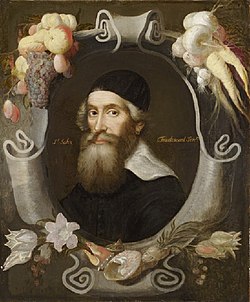
Philipa Gregory even dipped her toes in gay historical fiction. Her "Earthly Joys" is about the famous gardener John Tradescant the Elder who (in her book) ends up falling for the betwitching First Duke of Buckingham who was almost certainly bisexual and King James I's favourite. However attractive this book is--and I thoroughly enjoyed it, I had to stretch my imagination to breaking point to believe that the handsome Buckingham would have been even mildly attracted to Tradescant. But who knows? Perhaps he really was.
First Duke of Buckingham
George Villiers - First Duke of Buckingham
 
Tradescant
John Tradescant - not as handsome as Phillipa Gregory would have you think!

However - what I'd like to see is some damned good novels about real people going through times that we knew actually happened. The trouble is that there's so much been lost. Families who destroyed letters and diaries that would incriminate their sons as to their sexual preferences. People like Byron whose diaries were burned by order of his publisher. Oh! The loss of what they must have held! But there is a fair amount of information about gay characters--and more books are being written yearly (see the non-fiction section of The List) so if someone were to write something about Nijinsky and Diaghilev (why oh why hasn't someone done this already?) or Michelangelo - I'd certainly be standing in eager line waiting to snap them up. I do know an author who is working on a labour of love regarding Ivan the Terrible and his boy toy, but goodness knows when that will get done, (although it's going to be fabulous, I know!)

I mean, look at the Douglases. By that I mean Bosie and his brother. As far as I know (please please correct me if I'm wrong) but there's no book with an account of Bosie's experiences. And as for his brother? It's almost unknown that Francis Douglas who was older than Bosie, was somehow entangled with his boss, The Duke of Rosebery and a near-scandal ensued. Francis was granted a title by Rosebery and only 18 months afterwards (was it a pay off perhaps?) Francis was killed in a "hunting accident" although whether it was suicide, accident or something darker (seeing as how Rosebery was married into the Rothchild family...) Yes yes, supposition, but it's far less Wilde (excuse the pun) than Oscar as a detective!

Those devilishly handsome Douglas Boys (Bosie, left, Francis, Right.)
The Douglas Brothers, left-Bosie, Right, Francis


And when you think about it, one suddenly has a glimmer of sympathy (perhaps) for Lord Queensbury whose two sons were both involved with powerful older men. No wonder he went ballistic when Bosie went the same way.

Anyway - come on, authors! Where are the books about E M Forster? Wagner and Mad Ludwig? Siegfried Sasson? Clifton Webb? There are hundreds of subjects to choose from and only a handful of existing books. It's not right.

And if you don't, I may have to do it myself.

Further reading: Queers in History | Rictor Norton | Famous and Gay | List of Gay Men throughout History

Erastes is the penname of a female author living in Norfolk, England with 3 cats and a mad dog. She writes gay historical novels and short stories with gay themes from many genres. Her two books for Carina are: Muffled Drum (Austro-Prussian War) and A Brush with Darkness (coming out in March, which is set in 19th century Florence) Her website is www.erastes.com and she can be found easily on Twitter and just about everywhere else.

Thursday, January 05, 2012

Oh How I Hate Those Eggs and Ham


NOT a Regency Breakfast
I read a lot--and I read primarily gay historical romance for review for my review blog "Speak Its Name" and I admit I do like a good Regency. Gay romance goes well with Regency. The clothes and the manners and the insta-conflict for "you could be hanged for this" work well when it's done well, and mostly there are more good Regencies in the genre than otherwise.

But what annoys me hugely is that authors do their research for the Napoleonic War, the clothes, the manners, the slang, the carriages blah-de-blah-de-blah and then....

Their characters sit down and have a meal. And 9 times out of 10 I'm gnashing my teeth because it's just all wrong.

Authors seem forget that like clothes and music and fashion and the docking of horses' tails--food changes with the ages. What people ate in medieval times (mostly meat) wasn't what they were eating in Victorian times and not what we were eating today.

I've read several Regencies recently where the protagonists sit down for breakfast and they have "ham and eggs." This is so wrong for so many reasons. I wonder if it is because that's what Americans used to eat for breakfast, or they think it's an ancestor of "eggs and bacon" which is what us English would like to eat every day but reach for the bowel-scraping muesli instead, or what--I don't know.


They tended to have a lot on offer--at least in the richer households. Jane Austen's mother noted the quantity of food on offer : "Chocolate, Coffee and Tea, Plumb Cake, Pound Cake, Hot Rolls, Cold Rolls, Bread and Butter and dry toast for me." Clearly they had no problems with carbohydrates! There would also be--perhaps a more masculine foodstuff--MEAT in abundance: eggs, cold fowl and partridge, ham, tongue and anchovy.

The Supersizers (an excellent series of food related historical programmes) list breakfast as follows in their "Go Regency" segment: Toasted bread (done over the fire,) seed cake, turtulong, marmalade jame, hot chocolate, tea.

It also irritates me hugely when tea is guzzled down by the bucketload and there's no mention of the little locked box (the tea caddy) to keep the thieving servants away from the precious commodity!

So come on, historical authors. If you can research the nitty gritty of a military campaign, if you know exactly how many buttons a lieutenant had on his jacket, if you know what a reticule is for, then for goodness sake - get the food right!**

**none of the Carina authors are guilty of course!  :D

Monday, December 12, 2011

Romancing a Christmas Past - Part 5

Part One

Part Two

Part Three

Part Four

Louisa spun around to meet the wickedest green eyes she had ever seen in her life. Angled like a cat's, they glittered madly in the candlelight, and suddenly Louisa, despite the solidity of the wall at her back, plus the fact that the ball continued in full swing and that they were in view of everyone-- felt decidedly unsafe.

She attempted to move past the man, but he sidestepped, so she was unable to avoid him. She felt herself blushing--stupid, how old was she?--so she lifted her chin and glared, cutting him with contempt, before attempting to pass again. With a smile he simply sidestepped and was in front of her again. Really, it was altogether too galling.

She cast her eye across to the nearest group, who were too busy watching the dancing to notice her discomfort. Why hadn't anyone seen she was trapped like this? If she had been Amelia, she thought with chagrin, a handful of men no doubt would step to her rescue, but then Amelia was a wealthy pretty--minx--not a widow. Widows were considered able to look after themselves, and certainly a match for an unwanted advance.

"Sir," she said, filling her voice with venom. "Let me pass."

"Mais, mademoiselle..."

She'd heard voices like his before. Émigrés with one thought on their mind, to marry wealthily to make up for all they had lost in France. Lazy foreigners, all of them, every man jack of them.

"Madame," she snapped. "We have not been introduced, sir. Such proprieties are no doubt unimportant in Paris these days, but here in England we are made of better things."

The infuriating man had the gall to smile again. "You mistake me...madame" he said with an over-exaggerated bow. "Your virtue is safe with me, which is rather the point of my private discourse."

"Hardly private!" The words were out of her mouth before she could stop herself.

"I can assure you, ma chére, we have more privacy--and are regarded with far less suspicion-- here than we would be if we attempted to find a more secluded place to talk."

"I have nothing to say to you. Let me pass."

"But I have something to say to you. I am sure a lady of your discernment, your experience saw through the little Slockholme's trap. I know that you and the distingue milor' Ambry are good friends, but I'm afraid that is all you two will ever be."

"He's already made that clear," she said, turning away and looking blindly out at the dancers. Mutton. It stung her more than she had thought it ever could.

"Oh, don't envy Miss Slockholme; all Ambry wants is a wife to cover his real attachment..."Louisa found herself listening despite herself. She refused to give the man the benefit of a response and kept quiet. 

"Surely," he said, "you've noticed his partiality? Non? You surprise me. He isn't only susceptible to the fair sex, my dear. He dotes on the quite unfair sex aussi." Louisa frowned, baffled, and he gave a small laugh as if amused by her naïveté. "Ah, oui. How can I put it more delicately? Cherchez le homme."

"No," Louisa breathed. "No. It's not true. Richard...Richard and I..."

"Oh, he's very clever--and didn't you know, ma chére, that some men like both the grape and the grain? He will play the Hervey - surely you remember the stories of him? A leg in each camp, as they say. Smile, you've gone quite pale, you don't want people asking questions. Not now, do you?"

"I don't believe you," she said.

"Oh, it's quite true. Why do you think Richard was in the garden?" He produced the note that Amelia had dropped in the snow. "I saw him cast this aside when he was confronted. As you can see, it's most definitely addressed to him. And who is this Thomas? A pretty mystery, is it not?

Her hand shook as she read the note. It was a masculine hand. "What if I were to bring this to Ambry's notice? Ask him of this? I could denounce you..."

"I don't think you'd do that, Lady Carmichael. And believe me, if you were to do so, it would bring you no joy. To the world, you would be enmeshed in a most sordid complication… even if it were not true. Forget about him, Lady Louisa. Find yourself a man who can give you what you want." He touched her face gently, then swaggered off towards the conservatory.

After the man had gone, leaving her more breathless than she liked, she leaned against the moulded wall for a moment or two, thinking about what the man had said. Richard? No. It couldn't be. It was not to be countenanced, surely! They'd been lovers...surely to goodness it would be obvious? I am no ingenue, she thought, blood rushing to her head, making her cheeks glow with warmth. I know a man's touch, a man who wants me. I would...

But then she remembered the scandals around the ton over the past decade. Some she had been too young to understand until recently. Men who went abroad, leaving their wives behind, taking their devoted male friends or their secretaries. Conversations in drawing rooms with groups of dowagers which stilled the moment a certain fop or dandy entered the room, arm in arm with a close friend. Lord Hervey--a good many years before, but still the scandal lingered. He had been married, he had had children--and had kept a...friend (Louisa's mind shunned any word more coarse) for years.

His poor wife. That was what everyone said.

Well, I will not be an object of pity, she thought with savage decision. But I must know who...who was the man? She hurried towards the conservatory herself to catch up with the count and question him. Stepping into the huge glass space, she could hear voices. There were no lights here, only the light of the moon pouring in the windows, giving the huge tropical plants a monstrous appearance.

A male voice sounded loud in the echoing space. She couldn't quite make out the words, so she crept nearer. It wasn't a French voice, she could tell that much. "Yes. Kiss me again. Quickly. I can't be away long. You are sure it will work?"

What woman would be risking her reputation like this? Other than me, she added to herself. The question was answered for her as the very recognisable tones of the Comte followed.

"I guarantee it," the Comte's voice sounded muffled, as if pressed against...Louisa felt faint. There was a compunction to step forward. To see. But she resisted it with all her will and continued to listen. The men were quiet for half a minute and then the Comte continued. 

"The note dropped made it even easier. It was the work of a minute to append Ambry's name to it. Now the path is free for the fair Amelia. Lord Ambry might have tried to protect himself against Amelia's accusations by using Lady Louisa Carmichael as a shield, but that door will now be firmly closed to him. Lady Carmichael will not sully her name further than she has to take a risk on a suspected sodomite, and she will, I'm sure, discreetly pass the information to any other eligible ladies. And once our dear little Amelia is ensconced as Lady Ambry--and realises just how she got there, and how easily we could tear her down again--we can begin to reap the benefits, both financial and otherwise. Amelia's pillow talk is famous--we'll have secrets pouring into our laps."

"You've done well," the other man said. Louisa didn't recognise the voice. "You'll find that the French government will not be ungenerous."

"As long as I get my pardon," the comte said, "and a ... small consideration."

"My dear Thomas, won't this do on account?" There was a rustle of clothing and Louisa took the opportunity to back away before she fainted dead away on the floor.

Richard. Oh, no. What on earth was she to do?

Erastes

The talented Eliza Knight will be picking up the story on the 14th, so be sure to stop by to see where our story goes from here.

And don't forget: Each post will contain the name of a Christmas carol. As readers, you're asked to follow the blog and then post a comment on each entry naming that carol. The person with the most correct answers will win a bundle of SEVEN fabulous Carina historical novels to keep them entertained over the festive period, and beyond.

Wednesday, November 02, 2011

A Bluffer's Guide to Gay Historicals

Top facts:

* Once non-existent, the genre stands proudly, and there are hundreds and hundreds of titles to choose from in every possible era from cavemen to WW2
* Covers. Getting better and better every year, we've gone from naked men in a frozen pond to covers with ships and everything!
* Writers of the genre here at Carina: 
Erastes, Josh Lanyon, Aleksandr Voinov, Fae Sutherland, Bonnie Dee, Alex Beecroft, Charlie Cochrane (the latter two have books coming out in 2012)


In a nutshell

* There's still not enough of it, for a start. Yes, I'm never satisfied...
* Some Gay Historicals address the very real problems of being gay in a time when it wasn't just unacceptable, it was reviled and illegal. (Basically after Christianity kicked in) However, there were times when man on man love wasn't just acceptable, it was a normal part of everyday life. (The Greeks had a word for it.)
* Thankfully, due to pronouns there are few books with those classic romance titles such as "The Belgian Captain's Depraved Toyboy." (With thanks to the Random Romance Title Generator)

The Heroes


Not too different from the heroes in other historical romances. They are generally aristocratic (tall and handsome goes without saying - plus they are ALWAYS - always hung like horses, this is the law.)

So, create your character: Rich, check. Commanding, check. Handsome, check. Package of unusual size. Check and double check. OK, you can stop checking now.

The, er, OTHER Heroes

Now here you can play around a little. You can either make your other hero a match for your arrogant alpha in every sense of the word (and sit back and watch those sparks fly and those buttons go flying (gotta have flying buttons, more later) OR you can create a sensitive little soul. A downtrodden artist, perhaps, or an impoverished tutor. A kidnapped slave or an abused and rescued young man. As long as you get a vast gulf between your alpha and your omega, it doesn't really matter. Any excuse to make that boy cry his little heart out because the rough tough alpha doesn't know how to handle him. Or rather - he doesn't know how to handle his feelings - he knows how to handle him all right. (hur hur) The important thing is the desecration of innocence - but don't worry. No matter how nasty the alpha is, your sensitive soul will fall in love with him as he tops from the bottom.

The best bit about writing gay historicals
* Buttons
. Oh GOD the buttons. I've coined the term breeches ripper before, but for me waistcoat ripping is far more exciting. Also cravats. You can have a LOT of fun with cravats.
* UST. (No, no, not there, Unresolved SexualTension. Buckets and buckets of it. "I'm homosexual!++ Argh! God he's pretty. I wonder if he's homosexual too? How can I let him know? What if he's not? All right... so he is - he's sleeping with Lord [Whossit] - how can I get him?"A writer of gay historicals have immense fun torturing her characters - making every glance count, and when one's passing the port (to the left, of course) at dinner, fingertips are just bound to brush against each other.
* It's much easier to get men together on a day-to-day basis. Whereas a hetero historical writer will have to write about dances, and chaperones and perhaps elopements men can simply hang out with each other, ride in each other's carriages (and no, that's not a euphemism!) without anyone fainting or ruining anyone's reputation. Of course it's pretty difficult to get them into sexual situation, but that's another post...

The best bit about reading gay historicals* Buttons! Ok, Is it just me and the buttons?
* Appreciating that the author knows exactly what the difference is between a sailor's whipping and a double fisherman but that you don't need to know anything as silly as long as the hero gets tied up.
* Sponge baths.
* The membrum virilus! Members, yards, rods, poles, perches, arbor vitae, gaying instrument. (yes, really.)

Top tip: beige...biscuit...blasé bleeding anachronisms

Check check check. You may think that it's all right to say your hero's breeches are beige but it wasn't so and any eagle eyed reader will Mock You. They will, however realise if you are trying and make a small slip-up, but they won't appreciate sloppy (or no) research, modern day speech patterns and contemporary men in fancy dress.

What not to say

* “Gad, that's an attractive ass!”

Over to you...

* What gay historicals would you like to see?
* What cliches are you sick of?
* What do you think of the covers these days?
* Anything else?

And if you are interested in finding out more: (and in a more sensible fashion)

Speak Its Name has The Definitive List of Gay Historical fiction.
The Macaronis: Fiction out of the Closet


Erastes is the penname of a female author who lives in Norfolk, UK with 3 demanding cats and a mad dog. Her new novella, "A Brush With darkness" a gay romance set in 19th century Florence is coming to Carina in March 2012. Check her website for her non-Carina titles www.erastes.com

Wednesday, October 19, 2011

Which time era do you avoid?


You know when you have one of those massive barrels of sweets – usually at Christmas over here in the UK. Quality Street’s the nation’s favourite and they have a great selection of sweets in them. Nut clusters, caramel cups, toffees, fudge etc etc.
And then Christmas is over, and you are left with a handful of sweets that no-one wants. Orange, Strawberry and COFFEE creams. BLEURGHK.
Now this is obviously only indicative of what my family like – I’m sure there are lots of people who love these flavours, but it does seem to be coffee that is the least favourite, if the brilliant Revels Roulette adverts are anything to go on.


And where am I going with this??? Well, as you probably know, or don't - I run a Gay Historical Review blog called "Speak Its Name and I have to review the books that I'm given, or are available. I don't have the luxury of saying "I don't like...." and pushing them back into the sweetie barrel, because that wouldn't be fair.
But I have found that I AM being unfair - and that about half the books I have to be reviewd are Westerns, and that's probably because I've been skipping the westerns in favour of other time eras. I hate to say it, but I’ve found that westerns are my coffee creams.
And I’m sorry about this. I don’t think there are more westerns written than any other gay historical — although, this might be the case, I’ve not done a fact-finding mission to find out — it’s just that, because I’m not mad on the genre, I tend to put them to one side and then I end up with a ton of them to do at once–which doesn’t do anything for my temper or the balance of the site.
I don’t know when I stopped being a fan of the western, either. I used to love them as a child and even went to the cinema to catch classics such as True Grit, and I was such a huge fan of Rawhide (Gil Favour for the win) but now I tend to avoid most of them, except for homoerotic goodness such as The Searchers. (Yes, really. If you don’t believe me, go and watch it again, John Wayne’s character is most certainly bisexual at the very least.)
The very worst western (for me) and one that will make me run screaming from the sofa is anything Mexican. Don’t ask me why. I like Mexico. I like Mexican food. I'm really fond of Speedy Gonzales. But give me a western set in Mexico and I bite the coffee cream in half and spit it out.
I like coffee to drink, and I LOVE strawberries and oranges so nothing really makes sense.
And my aversion to western gay fiction makes no sense either because there’s been a good few that I’ve really enjoyed. Mark Probst’s “The Filly” is a beautifully written restrained piece of fiction, Jamie Craig’s “Those Who Cherish” was highly enjoyable, and Kiernan Kelly’s “In Bear Country” duet of books have everything necessary for a reader, adventure, romance and a good historical feel.
So I don’t know why I’ve got this westernphobia. Perhaps it’s because for every good book, there’s three not so stellar with more cliches than tumbleweeds, but then that’s true of every kind of fiction really isn’t it?
Perhaps in future for reviews I’ll take a tip from the Russian Roulette advert and just pick a book blindfold and not allow myself to push the least favourites to the back of the drawer.
Is there any genre you find yourself avoiding? Is there any logical reason for it (unlike me!)
Erastes
Erastes writes gay historicals, and her first book for Carina is "Muffled Drum" (set during the Austro Prussian War) out now. Her second will be "A Brush with Darkness"
Neither of them are westerns.
www.erastes.com

Wednesday, August 03, 2011

Striking a Balance


Last week, there was held--in Milton Keynes, UK, the second annual meetup of authors who write GLBT Fiction. It started in 2010 with just 12 of us meeting up in Ely library, but this year we had writers coming from all over the UK and even one or two from Europe and America! Over 40 attendees for our second year, and we even had three male writers attending which was SO encouraging.

The website is here, for those who are interested. We are planning something even bigger next year, perhaps over 2 days. Stay tuned!

Anyway, the reason I've done a bit of seemingly off topic promo is to mention the panel I participated in. Alex Beecroft, Charlie Cochrane and I spoke on Gay Historical Fiction and some of the pitfalls that authors fall into when attempting the genre.

The pitfalls, however, aren't limited to writers of gay historical fiction, of course! This is my talk, and I hope you find it useful. If you are interested, the whole panel of all three talks is posted HERE.

So here's my segment - Striking a Balance.

I’m going to talk about balance, because sometimes I think writers have difficulty striking a balance when writing. not just historical either. It’s a Fine Line between THIS IS MY RESEARCH LET ME SHOW YOU IT – and just getting the details right.

Don’t get e wrong—you got to do the research. You’ve got to try your very best to get those details right. Readers are forgiving if they can see you’ve worked like stink, but have made one or two silly errors. In Muffled Drum I made a big thing of the Red Light District in Berlin – and too late too late two people pointed out that the street I mentioned was actually in Hamburg and not Berlin.

But readers will be less forgiving if it’s patently obvious that you haven’t even bothered to use Google to check the most basic of facts.

But you shouldn’t over do relating that research to the reader and it’s this that is a little unfair to the writer, because you are going to learn a LOT more than you’ll ever put in the book.

I have to reference Dan Brown here, who does—and i have to grit my teeth to say this—write a damned good page turner. I actually own all of his books, because they are like crack. But whereas he writes a racketing good read and I for one can’t wait to turn the page and find out what’s happening next, he lets himself down with his signature move of telling us everything about everything. I remember reading one of them, don’t know which…and it told you about the engine of the car he was driving and the type of plane he was on, down to –it seemed, every grommet and washer. I found myself flipping over pages of STUFF HE HAD TO TELL YOU BECAUSE BY GOD HE’D DONE THE RESEARCH AND YOU SHALL SHARE IT rather than simply absorbing some of the facts as the flavour of the book.

I got the impression that he was saying to the reader “Look, i slaved over this book. i did research about Russia and China and every conspiracy theory known to man. Look, I seriously worked hard. I spent hours in libraries. you need to see my research or you’ll think i just made it up!!!! It will all be wasted if I don’t write it all down!” and that’s not good, that’s not the message you want to give. I don’t want the author to intrude at all.

I can relate to this, and I felt much the same when I first started to write, but luckily my mother was around when I first started and she pointed out that we didn’t need to know every single detail and she went through and deleted many descriptive words and passages. After that I found it much easier. The trick to it for me was to walk across my own room and described how I did it. I left the sofa, walked past the tv and the dining table to the kitchen. What I didn’t do was to leave the Gillows sofa, walk across the Wilton carpet designed by XXXX in 1792 and the flat screen 32” plasma screen Sony TV (I wish) and into the bespoke B&Q kitchen stencilled with green and yellow flowers.

Modern books don’t do this (or at least they shouldn’t!) and so neither should historicals. Whether the chair is made my Chippendale or whoever doesn’t really matter. Unless it does, of course. If the story revolves around Chippendale and perhaps the theft of a chair made by him, or whether the provenance of the chair is IMPORTANT then that’s fine. But if the detail doesn’t add anything to the story — and in fact, as often happens (Dan, I’m looking at you) intrudes and distracts from the story — then leave it out.

It doesn’t mean that you can’t make the description lush and tangible. Alex, for example, particularly in her 18th century paranormal “Wages of Sin” WORKS magic with her details. How cloth feels, how candle light looks and smells (never forget the smells) what happens to wig powder when it rains. But none of it is infordumping. She is simply creating a real and entirely believeable and visual world that the 21st century reader isn’t familiar with. The details immerse the reader, so they are actually there, and they are participating in historical events rather than distancing the reader, and makingit more clear that they are simply reading a book.

A good beta is worth their weight in gold. A good beta (and not just one who will tell you how great you are!) will tell you if you’ve turned into Dan Brown and you are oversharing that research.

The depressing fact of life is, that 99 percent of the research you will do for your book will (should!!) never appear on the pages of your book, but you can’t skip that research because it will make your book and more 3-dimensional, and in response to that, more enjoyable to read.